
Ganglion Cyst in Boise
Ganglion Cyst in Boise
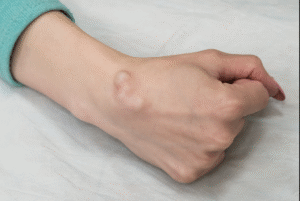
A ganglion cyst is a noncancerous, fluid-filled lump that most commonly develops along the tendons or joints of the wrist or hand. The cyst is filled with a thick, clear, jelly-like fluid similar to the fluid that lubricates joints and tendon sheaths. Ganglion cysts are the most common soft tissue mass found in the hand and wrist.
Ganglion cysts can vary in size — they may be small and barely noticeable, or grow large enough to be visually prominent. They may appear suddenly or develop gradually, and their size may fluctuate over time, often increasing with activity and decreasing with rest. While many ganglion cysts are painless, they can cause discomfort if they press on nearby nerves or interfere with joint movement.
Contributing factors
- Joint or tendon irritation — ganglion cysts are thought to arise from weakness or micro-damage to the joint capsule or tendon sheath, allowing joint fluid to leak out and collect in a cyst
- Repetitive wrist or hand use — activities that place repeated stress on the wrist or hand joints may increase risk
- Previous injury — prior sprains, fractures, or other trauma to the wrist or hand can predispose to cyst formation
- Underlying joint conditions — osteoarthritis of the finger joints, particularly at the base of the fingernail (mucous cyst), is associated with ganglion cyst development
- Age and gender — ganglion cysts are most common in women between 20 and 40 years of age, though they can occur in anyone
Symptoms
- A visible or palpable round or oval-shaped lump, most commonly on the back of the wrist
- The lump may be firm or slightly spongy to the touch
- Pain or aching at the site of the cyst, especially with wrist or hand activity
- Size fluctuation — the cyst may grow larger with increased activity and shrink with rest
- Numbness or tingling if the cyst is pressing on a nearby nerve
- Weakness in the affected wrist or fingers (less common)
- Some ganglion cysts are “occult” (hidden) and may not be visible but can still cause pain
Treatment
- Observation — if the cyst is not painful and does not interfere with function, it can simply be monitored. Many ganglion cysts resolve on their own over time.
- Immobilization — a brace or splint may be used to temporarily restrict wrist movement. Reduced activity can cause the cyst to shrink, which may relieve pressure on nearby nerves.
- Aspiration — a needle can be used to drain the fluid from the cyst. This is a simple office procedure that can provide relief, though the cyst may recur because the root (stalk) of the cyst remains.
- Surgery (excision) — if the cyst is painful, limits function, or recurs after aspiration, surgical removal may be recommended. The procedure involves removing the cyst along with a portion of the involved joint capsule or tendon sheath (the root of the cyst) to reduce the likelihood of recurrence. This is typically performed as an outpatient procedure.
When to seek care
If you develop a lump on your wrist or hand that is painful, growing, interfering with activity, or causing numbness or tingling, evaluation by a specialist is recommended. While ganglion cysts are benign, it is important to have any new mass evaluated to confirm the diagnosis and rule out other conditions.