
Dupuytren’s Contracture in Boise
Dupuytren’s Contracture in Boise
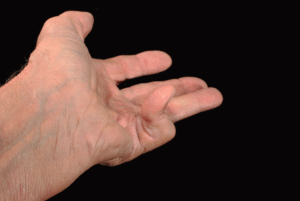
Dupuytren’s contracture is a progressive hand condition in which the fibrous tissue (fascia) beneath the skin of the palm thickens and tightens over time, forming firm cords and nodules. As the condition progresses, these cords can pull one or more fingers into a bent (flexed) position toward the palm, making it difficult or impossible to fully straighten them. The ring and small fingers are most commonly affected, though any finger can be involved.
Dupuytren’s contracture typically develops slowly over years and is not caused by an injury. While not painful in most cases, the contracture can significantly interfere with daily activities such as shaking hands, placing the hand flat on a surface, wearing gloves, or grasping large objects. Early evaluation can help determine the best time to intervene.
Contributing factors
- Genetics / family history — Dupuytren’s contracture has a strong genetic component and tends to run in families, particularly those of Northern European descent
- Age and gender — most common in men over 50 years of age
- Diabetes — individuals with diabetes have a higher incidence of Dupuytren’s contracture
- Alcohol use — chronic heavy alcohol consumption is associated with increased risk
- Smoking — smoking contributes to degeneration in connective tissue and is associated with increased risk and severity
- Seizure disorders — certain anti-seizure medications and epilepsy are associated with higher incidence
Symptoms
- Firm nodules or lumps in the palm, typically near the base of the ring or small finger
- Thickened, puckered, or dimpled skin on the palm
- Thick cords of tissue extending from the palm into the fingers
- Progressive inability to straighten one or more fingers fully
- Difficulty placing the hand flat on a table or into a pocket
- Interference with gripping, grasping, or performing daily tasks
- Occasional tenderness of the nodules, particularly early in the condition
Treatment
- Observation — in early stages with nodules only and no contracture, the condition may simply be monitored over time. Not all cases progress to the point of requiring treatment.
- Needle aponeurotomy (percutaneous fasciotomy) — a minimally invasive office procedure in which a needle is used to divide the thickened cord and restore finger extension. Recovery is typically rapid.
- Collagenase injection — an injectable enzyme (collagenase) may be used to weaken the cord, which is then manipulated to straighten the finger in a follow-up visit. Availability of this treatment may vary.
- Surgery (fasciectomy) — if the contracture is significant or recurrent, surgical removal of the thickened fascia may be recommended. Surgery provides the most thorough treatment and is typically performed as an outpatient procedure. Recovery involves hand therapy to restore motion and manage swelling.
- Physical / occupational therapy — therapy is often recommended after procedural or surgical treatment to maximize finger extension, reduce swelling, and restore hand function. Splinting may be used to maintain correction.
When to seek care
If you notice firm nodules developing in your palm, difficulty straightening your fingers, or progressive loss of hand function, evaluation by a specialist is recommended. The “tabletop test” — the inability to place the palm flat on a table — is a commonly used indicator that treatment may be appropriate. Early consultation allows for discussion of treatment options and timing.